

- Chandigarh UT
- Creative Corner
- Dadra Nagar Haveli UT
- Daman and Diu U.T.
- Department of Administrative Reforms and Public Grievances
- Department of Biotechnology
- Department of Commerce
- Department of Consumer Affairs
- Department of Industrial Policy and Promotion (DIPP)
- Department of Posts
- Department of Science and Technology
- Department of Telecom
- Digital India
- Economic Affairs
- Ek Bharat Shreshtha Bharat
- Energy Conservation
- Expenditure Management Commission
- Food Security
- Gandhi@150
- Girl Child Education
- Government Advertisements
- Green India
- Incredible India!
- India Textiles
- Indian Railways
- Indian Space Research Organisation - ISRO
- Job Creation
- LiFE-21 Day Challenge
- Mann Ki Baat
- Manual Scavenging-Free India
- Ministry for Development of North Eastern Region
- Ministry of Agriculture and Farmers Welfare
- Ministry of Chemicals and Fertilizers
- Ministry of Civil Aviation
- Ministry of Coal
- Ministry of Corporate Affairs
- Ministry of Culture
- Ministry of Defence
- Ministry of Earth Sciences
- Ministry of Education
- Ministry of Electronics and Information Technology
- Ministry of Environment, Forest and Climate Change
- Ministry of External Affairs
- Ministry of Finance
- Ministry of Health and Family Welfare
- Ministry of Home Affairs
- Ministry of Housing and Urban Affairs
- Ministry of Information and Broadcasting
- Ministry of Jal Shakti
- Ministry of Law and Justice
- Ministry of Micro, Small and Medium Enterprises (MSME)
- Ministry of Petroleum and Natural Gas
- Ministry of Power
- Ministry of Social Justice and Empowerment
- Ministry of Statistics and Programme Implementation
- Ministry of Steel
- Ministry of Women and Child Development
- MyGov Move - Volunteer
- New Education Policy
- New India Championship
- NITI Aayog
- NRIs for India’s Growth
- Open Forum
- PM Live Events
- Revenue and GST
- Rural Development
- Saansad Adarsh Gram Yojana
- Sakriya Panchayat
- Skill Development
- Smart Cities
- Sporty India
- Swachh Bharat (Clean India)
- Tribal Development
- Watershed Management
- Youth for Nation-Building
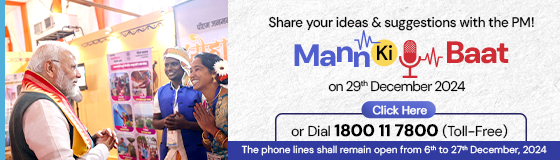
Inviting Ideas for Mann Ki Baat by Prime Minister Narendra Modi on 29th December 2024

Start Date :
Dec 06, 2024
Last Date :
Dec 27, 2024
23:45 PM IST (GMT +5.30 Hrs)
Hon'ble PM Narendra Modi looks forward to sharing his thoughts on themes and issues that matter to you. Prime Minister invites you to share your ideas on topics he should address ...
All Comments
Featured
New Comments
Comments (1)
Comments (1)
Comments (1)
Comments (1)
Comments (1)
Comments (1)
Comments (1)
Comments (1)
Comments (1)
Comments (1)
Showing 7459 Submission(s)
Bisathi Bharath
1 year 8 months ago
To choose on the basis of gender and eliminate new life if the gender is not ‘favourable’ can easily be among humanity’s worst moments. It is time again for the government to ramp up awareness building exercises, and this time use technology to monitor every single pregnant woman right down to taluk levels until at least one year after birth. While punitive aspects might offer a measure of deterrence, true change can only be brought about by a change in attitude. As Amartya Sen argued: while at birth boys outnumber girls, ‘after conception, biology seems on the whole to favour women’. The weapon that the government needs to use now is one that will be powerful enough to eliminate the perversion of son preference from people’s minds.
Like
(3)
Dislike
(0)
Reply
Report Spam
Bisathi Bharath
1 year 8 months ago
To choose on the basis of gender and eliminate new life if the gender is not ‘favourable’ can easily be among humanity’s worst moments. It is time again for the government to ramp up awareness building exercises, and this time use technology to monitor every single pregnant woman right down to taluk levels until at least one year after birth. While punitive aspects might offer a measure of deterrence, true change can only be brought about by a change in attitude. As Amartya Sen argued: while at birth boys outnumber girls, ‘after conception, biology seems on the whole to favour women’. The weapon that the government needs to use now is one that will be powerful enough to eliminate the perversion of son preference from people’s minds.
Like
(3)
Dislike
(0)
Reply
Report Spam
Bisathi Bharath
1 year 8 months ago
A radical shift in the approach moving from protection of girl child to promotion of women as a category is the need of the hour.
This is done not just by improving the image of the girl child but increasing the value of the girl child.
A rights-based lifecycle approach with focus on nutrition, health, education, equal entitlements in property rights, employment and income generation is the need of the day.
Finally, only an over-arching gender sensitization programme focusing at the individual level through education, at the institutional level, public and private, at societal level through professional behavioural campaign is the only way to not add more to the shameless inventory of ‘Missing Millions’.
Like
(3)
Dislike
(0)
Reply
Report Spam
Bisathi Bharath
1 year 8 months ago
One in nine females below the age of 5 die due to postnatal sex selection.
It tends to be higher among wealthy families, but percolates down to lower-income families over time, as sex selection technologies become more accessible and affordable.
The skewed ratio causes the number of prospective grooms to outnumber prospective brides, which further results in human trafficking for marriage as well as child marriages.
However, the positive news is according to the report, advances in India have contributed to a decline in child marriages in South Asia. This corroborates the NFHS data which had said that child marriage in India fell from 47% in 2005-’06 to 26.8% in 2015-’16.
Like
(4)
Dislike
(0)
Reply
Report Spam
Bisathi Bharath
1 year 8 months ago
Key findings of the report in India
One in three girls missing globally due to sex selection, both pre- and post-natal, is from India, i.e. 46 million out of the total 142 million.
India has the highest rate of excess female deaths at 13.5 per 1,000 female births or one in nine deaths of females below the age of 5 due to postnatal sex selection.
In India, around 460,000 girls went missing at birth, which means they were not born due to sex-selection biases, each year between 2013 and 2017.
India (40%) along with China (50%) account for around 90% of the estimated 1.2 million girls lost annually to female foeticide.
Like
(3)
Dislike
(0)
Reply
Report Spam
Bisathi Bharath
1 year 8 months ago
The demographic transition in India has brought along an ugly unintended consequence – a historically strong preference for sons over daughters in these societies has strengthened with the decline in fertility, thus worsening the female-male sex ratio at birth.
Recently, the United Nations Population Fund (UNFPA) has released the State of the World Population 2020 report, titled ‘Against my will: defying the practices that harm women and girls and undermine equality’. It highlights at least 19 human rights violations against women and focuses on the three most prevalent ones, Female Genital Mutilation (FGM), extreme bias against daughters, in favour of sons and child marriage.
Like
(3)
Dislike
(0)
Reply
Report Spam
Bisathi Bharath
1 year 8 months ago
It increases total fertility of women by 17 percent, which hurts developing countries battling high population growth.
As per IRCW study, the welfare benefit in ending child marriage is estimated to be $22.1 billion globally in the first year (2015). This number increases to $566 billion annually by 2030, for a cumulative welfare benefit of more than $4 trillion. Considering how one out of three such marriages happen in India, this impact is huge on India.
Decreased household sizes would lead to an increased availability of funds which then could be used to pay for food, education, health care and other expenses for other members of the household.
Like
(3)
Dislike
(0)
Reply
Report Spam
Bisathi Bharath
1 year 8 months ago
Impact of child marriage on Indian economy
Child marriage negatively affects the Indian economy and can lead to an intergenerational cycle of poverty.
Girls and boys married as children more likely lack the skills, knowledge and job prospects needed to lift their families out of poverty and contribute to their country’s social and economic growth.
Early marriage leads girls to have children earlier and more children over their lifetime, increasing economic burden on the household.
Child marriage is estimated to cost economies at least 1.7 percent of their GDP.
Like
(3)
Dislike
(0)
Reply
Report Spam
Bisathi Bharath
1 year 8 months ago
According to ChildLine India, across India 5,214 child marriages were reported in the first four months of lockdown between March to June.
UNICEF has said that in Madhya Pradesh where child marriages are a constant challenge, economic pressures due to the pandemic has pushed poor parents to marry off girls early.
As many as 204 child marriages were performed in 25 out of 33 districts in Telangana during the lockdown period from March 24 to May 31 in 2020.
Like
(3)
Dislike
(0)
Reply
Report Spam
Bisathi Bharath
1 year 8 months ago
Apart from poverty, weak law enforcement, patriarchal norms and concern about family honor are factors contributing to early marriage during the COVID- 19 pandemic.
West Bengal is one of the five states in India that have a high prevalence of early marriages. Though 12% of girls between 15 and 19 years of age are married off nationally, in West Bengal the figure stands at 25.6%.
Madhya Pradesh recorded 46 child marriages between November 2019 and March 2020, a figure that that jumped to 117 in just three months of the lockdown from April to June 2020, data provided by ChildLine India
Like
(3)
Dislike
(0)
Reply
Report Spam
- View More