Home | MyGov

Accessibility
Accessibility Tools
Color Adjustment
Text Size
Navigation Adjustment
Screen Reader iconScreen Reader

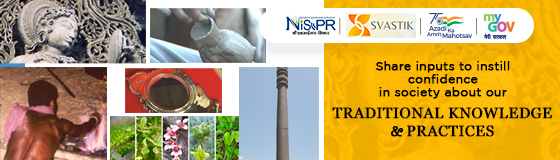
Share inputs to instil confidence in society about our traditional knowledge and practices

Share inputs to instil confidence in society about our traditional knowledge and practices
Start Date :
Mar 03, 2022
Last Date :
Aug 31, 2022
23:45 PM IST (GMT +5.30 Hrs)
Submission Closed

India has a rich legacy of practices and knowledge touching different spheres of life and a scientific heritage traversing various Science & Technology (S&T) domains. The ...

India has a rich legacy of practices and knowledge touching different spheres of life and a scientific heritage traversing various Science & Technology (S&T) domains. The traditional knowledge of India is available in various forms such as classical texts, manuscripts and/or as oral communication that has been passed on over thousands of years. This valuable knowledge is often part of our daily practices as well. Some of the traditional practices are livelihood means of the concerned knowledge holders. Our traditional practices exist in synergy between human needs and nature, often balancing resources and requirements in a local context. However, with time, India’s Traditional Knowledge Systems are eroding rapidly, and the nation has also been witnessing erosion in people’s faith towards our traditional knowledge. A grave concern is the mindless attitude of some to mimic non-Indian cultures and disdain for our traditions. It’s important to recognize that traditional heritage is an integral part of any country’s development and progression. This calls for necessary attention and action from the concerned stakeholders in the country to build further on our scientific inheritance. Only a well-informed and balanced society can drive the advancement of the country.

Under the visionary leadership of our Hon’ble Prime Minister and President, CSIR Society, Shri Narendra Modi, the Council of Scientific and Industrial Research (CSIR) is spearheading the efforts to collaborate with the relevant partners from across the country and implement the national initiative SVASTIK (Scientifically Validated Societal Traditional Knowledge) for communicating India’s traditional knowledge to the society. CSIR-National Institute of Science Communication and Policy Research (CSIR-NIScPR) is the nodal organization to implement this national initiative.

The prime mission of the initiative is to conserve scientifically validated traditional practices, and instil confidence in citizens regarding the scientific values of our traditional knowledge/practices.

We invite the suggestions of academicians, researchers, subject-matter experts, students, NGOs, and the public on how to instil confidence in society about our traditional knowledge and practices. This will help us in our mission to inculcate a scientific temper and instil confidence in citizens by stimulating the Science-Scientist-Society connect towards our traditional knowledge and practices.

Click here to read more about the SVASTIK Initiative of CSIR-NIScPR. (PDF 1519 KB)
Or visit the website - https://niscpr.res.in/nationalmission/svastik

How much are you aware of our traditional knowledge and practices? Participate in MyGov quiz and check your awareness of the traditional knowledge of India. Quiz Link: https://quiz.mygov.in/quiz/quiz-on-indian-traditional-knowledge/

The last date to share your ideas and suggestions is 31st August 2022.

Reset
Showing 2022 Submission(s)
YATIN VAISHAMPAYAN
YATIN VAISHAMPAYAN 4 years 4 months ago
traditional trends are a great subject for study of any critical problem with latest available tool and technique which gives unbelievable results and sustainable outcomes.
vivek kumar c
vivek kumar c 4 years 4 months ago
today's young educated person knowledge is what our grand parents already knows. hence the DOCUMENTING our traditional skill practice is the need of the hour. be it like traditional sword making skill, casting, carpentry, stone craving, etc . in this digital era preparing video content like prepared by NATGEO or DISCOVERY CHANNEL. can last longer and pass on the next generation. the new mission in this regard is required and on a time bound manner all these traditional skill need to be documented. hand holding of these traditional skill and passing on to the next generation through SKILL INDIA can reap fruits in near future.
Adv Praveen Pratap
Adv Praveen Pratap 4 years 4 months ago
सर, आपने विधिक सेमिनार में न्याय पर सकारात्मक स्पीच दी,उसके लिए बहुत बहुत धन्यवाद। सर कोई व्यक्ति का पद पर विराजमान होना,और उसका क्षमतावान होना,दोनो अलग विषय हैं। कोई व्यक्ति किसी प्रकार पद तो प्राप्त कर लेता है,लेकिन यह आवश्यक नहीं कि उसमे क्षमता हो। जैसे परेशानी यह नहीं है हर व्यक्ति डाक्टर,वकील,इंजिनियर,या नेता आदि हो,परेशानी वहां है,जो जिस पद पर है और उसके पास योग्यता भी है किंतु क्या उसके पास उस पद की क्षमता है या नहीं। अक्षम व्यक्ति पद प्राप्त करके मात्र शोषण ही करेगा,और भ्रष्टाचार करेगा।
Shriya Kundargi
Shriya Kundargi 4 years 4 months ago
While addressing the India International Science Festival, Prime Minister Narendra Modi said India has a rich legacy in science, technology and innovation and all efforts are being made to make India "the most trustworthy centre for scientific learning". Indian scientists have done path-breaking research in different fields. Our tech industry is at the forefront of solving global problems but India wants to do more," PM Modi said.
Usha sidana
Usha sidana 4 years 4 months ago
jai Bhart jai Hind Bhart ma Divors 60 to 70 %hony lagay hai Divorsee girls ko job jarruri jai ka is na to mabap support kerty hai na he sarkar esi ley bacha va ma victim bantu hair asa na ho every city magistat ko power ho vha post office hospital police ma Divorsee girls ko job da jo bhe hindu girls divorce hai HINDUSTAN society ko better banayjai hind
KULDEEP VISHWAKARMA
KULDEEP VISHWAKARMA 4 years 4 months ago
Traditional knowledge includes types of knowledge about traditional technologies of subsistence (e.g. tools and techniques for hunting or agriculture), midwifery, ethnobotany and ecological knowledge, traditional medicine, celestial navigation, craft skills, ethnoastronomy, climate, and others. *Examples include knowledge about traditional medicines, traditional hunting or fishing techniques, knowledge about animal migration patterns or water management.
S BALAJI
S BALAJI 4 years 4 months ago
To minimise no of divorce cases and maintain our indian culture during marriage a common minimum conditions or expectations accepted both by Bride and Bridegroom needs to be shared in front of relatives in marriage hall and signed by minimum of five blood relations in token of acceptance. In case of breaking promises the couples should first reconcile before signatories and with the help of a reputed community representative are commendation for break or continuity to be re corded. This document will serve as FIR in the family courts. This practice helps to reduce the divorce cases and also help the judiciary in trial as most of the divorce cases are advocates driven
Dr Sadashiv Mohapatra
Dr Sadashiv Mohapatra 4 years 4 months ago
There is generation gap between the preachers who had used , practised and reaped the benefits applying ⁹traditional knoweldge" in different fields.The present generation must be explained through scientific proofs.The educationalcurriculum from high school standard upwards must have topics based on benefit of using such traditional knowledge. It must be mandatory for pharma companies to manufacture medicines based on traditional knowledge and the health care providers should be made aware
Srikar Srivatsa Dahagam
Srikar Srivatsa Dahagam 4 years 4 months ago
(1)Starting a 6 Laner expressway connecting all shaktipeethas in India. (2)Building bhavya temple corridors with vedas library,gita bhavan,indigenous textile exhibitions,Ayurveda shops in the cities:Ujjain,Ramavaram Temple,Kanakadurga Temple,Ambaji Temple,Dwarkadeesh Temple,Hornaadu,Mahabalipuram Temple,Sabrimala,Haridwar,Somnath,Hajipur Temple,Puri Sun Temple,Maa Kamakhya Temple, Unakoti etc. (3) Playing songs of local folklore of Bhakti movements in the temple corridoors instead of recent songs (4) Increasing allocations for ministry of culture (5) Renaming stadiums after legends of Indian culture