Home | MyGov

Accessibility
Accessibility Tools
Color Adjustment
Text Size
Navigation Adjustment
Screen Reader iconScreen Reader

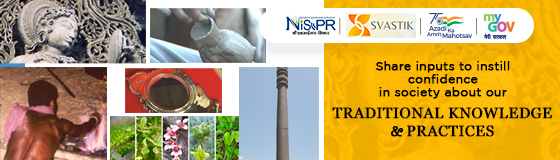
Share inputs to instil confidence in society about our traditional knowledge and practices

Share inputs to instil confidence in society about our traditional knowledge and practices
Start Date :
Mar 03, 2022
Last Date :
Aug 31, 2022
23:45 PM IST (GMT +5.30 Hrs)
Submission Closed

India has a rich legacy of practices and knowledge touching different spheres of life and a scientific heritage traversing various Science & Technology (S&T) domains. The ...

India has a rich legacy of practices and knowledge touching different spheres of life and a scientific heritage traversing various Science & Technology (S&T) domains. The traditional knowledge of India is available in various forms such as classical texts, manuscripts and/or as oral communication that has been passed on over thousands of years. This valuable knowledge is often part of our daily practices as well. Some of the traditional practices are livelihood means of the concerned knowledge holders. Our traditional practices exist in synergy between human needs and nature, often balancing resources and requirements in a local context. However, with time, India’s Traditional Knowledge Systems are eroding rapidly, and the nation has also been witnessing erosion in people’s faith towards our traditional knowledge. A grave concern is the mindless attitude of some to mimic non-Indian cultures and disdain for our traditions. It’s important to recognize that traditional heritage is an integral part of any country’s development and progression. This calls for necessary attention and action from the concerned stakeholders in the country to build further on our scientific inheritance. Only a well-informed and balanced society can drive the advancement of the country.

Under the visionary leadership of our Hon’ble Prime Minister and President, CSIR Society, Shri Narendra Modi, the Council of Scientific and Industrial Research (CSIR) is spearheading the efforts to collaborate with the relevant partners from across the country and implement the national initiative SVASTIK (Scientifically Validated Societal Traditional Knowledge) for communicating India’s traditional knowledge to the society. CSIR-National Institute of Science Communication and Policy Research (CSIR-NIScPR) is the nodal organization to implement this national initiative.

The prime mission of the initiative is to conserve scientifically validated traditional practices, and instil confidence in citizens regarding the scientific values of our traditional knowledge/practices.

We invite the suggestions of academicians, researchers, subject-matter experts, students, NGOs, and the public on how to instil confidence in society about our traditional knowledge and practices. This will help us in our mission to inculcate a scientific temper and instil confidence in citizens by stimulating the Science-Scientist-Society connect towards our traditional knowledge and practices.

Click here to read more about the SVASTIK Initiative of CSIR-NIScPR. (PDF 1519 KB)
Or visit the website - https://niscpr.res.in/nationalmission/svastik

How much are you aware of our traditional knowledge and practices? Participate in MyGov quiz and check your awareness of the traditional knowledge of India. Quiz Link: https://quiz.mygov.in/quiz/quiz-on-indian-traditional-knowledge/

The last date to share your ideas and suggestions is 31st August 2022.

Reset
Showing 2022 Submission(s)
kalpana jhajharia
kalpana jhajharia 4 years 4 months ago
For that skill development based study courses r need of time. Even for adults run program in which everything is taught from raw material to selling.
Parameshwaran
Parameshwaran 4 years 4 months ago
10 Golden Ways to Preserve Traditional Practices 1. Document and Share your culture's art and technology among your own community members for creating awareness 2. Attend or organize major events of your own tradition 3. Chatting and Spending time with other members of the community with curiosity and exchanging knowledge of your own traditions. 4. Learn about religious traditions and follow strictly and feel what your ancestors wanted to pass on 5. Speak your own ancestral language 6. Use your records to explore the forgotten culture 7.  Interview the people whose histories you're telling, or experts in the subject you're writing about. 8. Through promoting oral storytelling/songs/dances we may give life to the endangered traditional values. 9. You can record anything you've discovered through your research and life. 10. Record your family tree with the help of family members, adding to it as you go along.
PARTHA CHAUDHURI
PARTHA CHAUDHURI 4 years 4 months ago
I once spent time with a ‘Sadhak’ (seer) . Two interpretations imbibed from him are as follows: 1. ‘Kaali’ means the power that moves time (Kaal) in the destruction/creation event-cycle. It manifests on an eventless temporal platform, the ‘Mahakaal’. This is signified by the idol of Goddess ‘Kaali’ stepping on the chest of Lord Shiva, the ‘Mahakaaleshwar’ (Lord of Mahakaal) lying still. The question of time has puzzled the philosophers and the scientists for centuries. The complex theory of a curved space-time continuum has been devised. But another key to this question is hidden in the above symbolism. There might be a reader to pursue this interpretation. 2. The elephant can use its trunk for uprooting a tree or to lift a paper-pin from the floor. It also has a great memory. The mouse can very swiftly grab an opportunity. Both are unique in their special powers. Now think of Lord ‘Ganesha’, the Idol of Success riding on the mouse. Our idols carry very significant hints.
Shivam Gupta
Shivam Gupta 4 years 4 months ago
30-40 % of youth don't know about their passion or their future career So, our education system has to take responsibility for this to give traditional knowledge to them and teach biographies of successful people. and add the Granth in their course
indian
indian 4 years 4 months ago
जय श्री राम. in Mumbai you requierd a special police force called _श्री ब्रह्मचैतन्य 'EGO' लेस पोलिस .नॉन"EGO",istic police says "RAMA", is doer , other wise Due To Dirty Secularizam and har ghar politics you will find a common mumbaikar will luere to (मवाळ nationality ), Bowing down Attitude because thare is if no proper suppor system to common mumbaikar is very difficult to implement akhanda Bharat .and it is unity and please this is only for center not for state authority
Dr Ashwani kumar Mishra
Dr Ashwani kumar Mishra 4 years 4 months ago
Acharya Charak and Sushruta, Aryabhatta India govt should invest on research over our old age techniques Not only medicine...but for maths science, economics, civics, etc ...etc as our cultures have evolved for more than 5000 years ago not just 2200 yr ago. Every citizen irrespective of his religion must pay tax to benefit nation. some pay zakaat, fitraa for the benefit of Islam only I must say. Religious harmony be mentained but not at cost of nationalism. because people need india but india does not require bad citizens. strengthen the armed forces (police/defence) to tackle external threats, and people provoking from inside too. merge local parties and make only 2 major parties...hold elections all over the country on same day. watch situation in North East bihar and North Bengal before it gets worse by migrants who were brought voters. Law that governs minority, needs a demarcation of a limited population number to given minority status. less than 5% of Indian population.