

Home | MyGov

Accessibility
Accessibility Tools
Color Adjustment
Text Size
Navigation Adjustment
Screen Reader iconScreen Reader

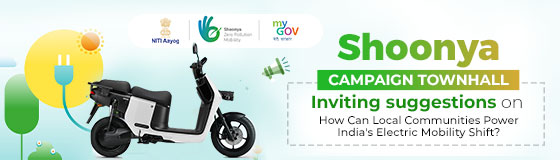
Shoonya Campaign Townhall - Inviting Suggestions On How Can Local Communities Power India's Electric Mobility Swift

Shoonya Campaign Townhall - Inviting Suggestions On How Can Local Communities Power India's Electric Mobility Swift
Start Date :
Feb 13, 2024
Last Date :
Mar 13, 2024
23:45 PM IST (GMT +5.30 Hrs)
Submission Closed

The NITI Aayog-led Shoonya campaign, in partnership with MyGov India, is thrilled to announce the electric vehicles Townhall, an open discussion platform for citizens to share ...

The NITI Aayog-led Shoonya campaign, in partnership with MyGov India, is thrilled to announce the electric vehicles Townhall, an open discussion platform for citizens to share valuable ideas and suggestions to promote and enhance the clean electric mobility ecosystem in India. The Townhall focuses on electric vehicles (EVs) and their associated advantages, including cost savings, clean air, health benefits, and emission reduction.

In line with this initiative, NITI Aayog in collaboration with MyGov, invites input from citizens.

To learn more about the Shoonya Campaign and discover the benefits of EVs, please visit the Shoonya campaign website at www.shoonya.info

Reset
Showing 973 Submission(s)
VIKASH KUMAR CHAUBEY
VIKASH KUMAR CHAUBEY 2 years 5 months ago
Infrastructure Development: The deployment of charging infrastructure is critical for the success of electric mobility. Local communities can collaborate with government bodies, businesses, and NGOs to identify suitable locations for charging stations, such as public parking lots, community centers, and commercial areas. Through public-private partnerships and community-led initiatives, communities can facilitate the installation of charging points, making EV charging accessible and convenient for residents.
VIKASH KUMAR CHAUBEY
VIKASH KUMAR CHAUBEY 2 years 5 months ago
Infrastructure Development: The deployment of charging infrastructure is critical for the success of electric mobility. Local communities can collaborate with government bodies, businesses, and NGOs to identify suitable locations for charging stations, such as public parking lots, community centers, and commercial areas. Through public-private partnerships and community-led initiatives, communities can facilitate the installation of charging points, making EV charging accessible and convenient for residents.
VIKASH KUMAR CHAUBEY
VIKASH KUMAR CHAUBEY 2 years 5 months ago
Infrastructure Development: The deployment of charging infrastructure is critical for the success of electric mobility. Local communities can collaborate with government bodies, businesses, and NGOs to identify suitable locations for charging stations, such as public parking lots, community centers, and commercial areas. Through public-private partnerships and community-led initiatives, communities can facilitate the installation of charging points, making EV charging accessible and convenient for residents.
VIKASH KUMAR CHAUBEY
VIKASH KUMAR CHAUBEY 2 years 5 months ago
Awareness and Education: Local communities serve as the grassroots level of society, making them ideal agents for spreading awareness and educating the masses about electric mobility. Community-driven initiatives such as workshops, seminars, and outreach programs can disseminate information about the benefits of EVs, charging infrastructure, government incentives, and environmental impacts. By fostering a culture of understanding and acceptance, communities can accelerate the adoption of electric vehicles.
VIKASH KUMAR CHAUBEY
VIKASH KUMAR CHAUBEY 2 years 5 months ago
Introduction: India stands at the cusp of a transformative shift towards electric mobility, driven by the imperative to mitigate climate change, reduce pollution, and achieve energy independence. Electric vehicles (EVs) offer a sustainable alternative to traditional fossil fuel-powered vehicles, but their widespread adoption requires concerted efforts from various stakeholders, including local communities. This essay delves into the pivotal role local communities can play in powering India's electric mobility swiftly.
VIKASH KUMAR CHAUBEY
VIKASH KUMAR CHAUBEY 2 years 5 months ago
Empowering Grassroots Innovation: Local communities are hubs of innovation, where grassroots initiatives can spark transformative change. Encouraging entrepreneurship and supporting local startups focused on electric mobility can accelerate the development of indigenous solutions tailored to India's unique needs and challenges. Community-driven innovation hubs and incubators can provide aspiring entrepreneurs with mentorship, funding, and access to markets, nurturing a thriving ecosystem of homegrown innovations in electric mobility.
VIKASH KUMAR CHAUBEY
VIKASH KUMAR CHAUBEY 2 years 5 months ago
Fostering Collaborative Partnerships: Collaboration between various stakeholders is essential for the success of India's electric mobility transition. Local communities can serve as catalysts for forging partnerships between government agencies, private enterprises, academic institutions, and non-profit organizations. By facilitating dialogue and cooperation, communities can leverage the expertise and resources of different stakeholders to overcome challenges and drive innovation in the electric mobility ecosystem.
VIKASH KUMAR CHAUBEY
VIKASH KUMAR CHAUBEY 2 years 5 months ago
Encouraging Sustainable Practices: The promotion of sustainable practices within local communities can further bolster the adoption of electric mobility. Initiatives such as carpooling, ride-sharing, and promoting active transportation modes like cycling and walking can complement the use of EVs, reducing congestion and emissions. Community-led efforts to develop pedestrian-friendly infrastructure and dedicated cycling lanes not only promote eco-friendly transportation options but also contribute to creating healthier and more livable urban environments.
VIKASH KUMAR CHAUBEY
VIKASH KUMAR CHAUBEY 2 years 5 months ago
Promoting Awareness and Education: Education and awareness are essential for dispelling myths and misconceptions surrounding electric vehicles. Local communities can organize workshops, seminars, and awareness campaigns to educate citizens about the benefits of electric mobility, including cost savings, environmental sustainability, and reduced air pollution. Additionally, community-driven initiatives can facilitate test drives and demonstrations, allowing people to experience electric vehicles firsthand and alleviate concerns about range anxiety and performance.
VIKASH KUMAR CHAUBEY
VIKASH KUMAR CHAUBEY 2 years 5 months ago
Building Infrastructure: Local communities play a pivotal role in building the necessary infrastructure to support electric mobility. From setting up charging stations to developing parking facilities tailored for EVs, community-driven initiatives can address the infrastructure gaps hindering widespread adoption. By collaborating with local authorities and businesses, communities can identify strategic locations for charging stations and incentivize their installation through crowdfunding or public-private partnerships.