Home | MyGov

Accessibility
Accessibility Tools
Color Adjustment
Text Size
Navigation Adjustment
Screen Reader iconScreen Reader

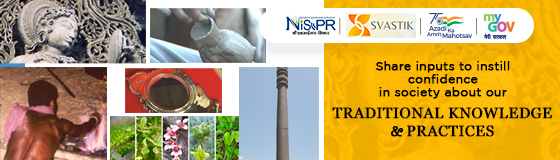
Share inputs to instil confidence in society about our traditional knowledge and practices

Share inputs to instil confidence in society about our traditional knowledge and practices
Start Date :
Mar 03, 2022
Last Date :
Aug 31, 2022
23:45 PM IST (GMT +5.30 Hrs)
Submission Closed

India has a rich legacy of practices and knowledge touching different spheres of life and a scientific heritage traversing various Science & Technology (S&T) domains. The ...

India has a rich legacy of practices and knowledge touching different spheres of life and a scientific heritage traversing various Science & Technology (S&T) domains. The traditional knowledge of India is available in various forms such as classical texts, manuscripts and/or as oral communication that has been passed on over thousands of years. This valuable knowledge is often part of our daily practices as well. Some of the traditional practices are livelihood means of the concerned knowledge holders. Our traditional practices exist in synergy between human needs and nature, often balancing resources and requirements in a local context. However, with time, India’s Traditional Knowledge Systems are eroding rapidly, and the nation has also been witnessing erosion in people’s faith towards our traditional knowledge. A grave concern is the mindless attitude of some to mimic non-Indian cultures and disdain for our traditions. It’s important to recognize that traditional heritage is an integral part of any country’s development and progression. This calls for necessary attention and action from the concerned stakeholders in the country to build further on our scientific inheritance. Only a well-informed and balanced society can drive the advancement of the country.

Under the visionary leadership of our Hon’ble Prime Minister and President, CSIR Society, Shri Narendra Modi, the Council of Scientific and Industrial Research (CSIR) is spearheading the efforts to collaborate with the relevant partners from across the country and implement the national initiative SVASTIK (Scientifically Validated Societal Traditional Knowledge) for communicating India’s traditional knowledge to the society. CSIR-National Institute of Science Communication and Policy Research (CSIR-NIScPR) is the nodal organization to implement this national initiative.

The prime mission of the initiative is to conserve scientifically validated traditional practices, and instil confidence in citizens regarding the scientific values of our traditional knowledge/practices.

We invite the suggestions of academicians, researchers, subject-matter experts, students, NGOs, and the public on how to instil confidence in society about our traditional knowledge and practices. This will help us in our mission to inculcate a scientific temper and instil confidence in citizens by stimulating the Science-Scientist-Society connect towards our traditional knowledge and practices.

Click here to read more about the SVASTIK Initiative of CSIR-NIScPR. (PDF 1519 KB)
Or visit the website - https://niscpr.res.in/nationalmission/svastik

How much are you aware of our traditional knowledge and practices? Participate in MyGov quiz and check your awareness of the traditional knowledge of India. Quiz Link: https://quiz.mygov.in/quiz/quiz-on-indian-traditional-knowledge/

The last date to share your ideas and suggestions is 31st August 2022.

Reset
Showing 2022 Submission(s)
SUTHAHAR P
SUTHAHAR P 4 years 3 months ago
Equity within traditional societies is multi-layered. There is clearly a hierarchy within societies regarding the division of rights and obligations due various members of a community. Stephen B. Kendie and Bernard Y. Guri use the case of traditional leadership in Ghana to highlight the importance of traditional governance to achieve development objectives, while at the same time showing the challenges to and opportunities for these traditional structures when they operate within a broader national governance framework.
SUTHAHAR P
SUTHAHAR P 4 years 3 months ago
To understand the significance of such knowledge systems, identify opportunities and challenges in their adoption through different models and experiments that have been initiated in various parts of the globe, and determine how they can possibly be integrated into a modern milieuwe believe that a sectoral understanding of contributions of TK will be useful. Hence, the chapters have been organized into categories dealing with production activities/services (agriculture, health, water management, biodiversity, arts, economic development), adaptive capacity (environmental management, climate adaptation), learning and governance processes (communities, women, education, governance, ethics and equity, intellectual property rights), highlighting in the process how traditional practices relevant to a sector or theme have been influenced by mainstream policies, and how again there is a move to include these practices in planning processes.
SUTHAHAR P
SUTHAHAR P 4 years 3 months ago
Traditional communities have, within the values of mutuality and reciprocity, obtained several services from the ecosystem – food (from agricultural activities and prey), water, medicine, crafts, spiritual satisfaction (e.g., sacred groves, totems, etc.), among others. To reiterate a point made earlier, since the sustained availability of these products and services was (and still is) crucial to their livelihoods and well-being, traditional communities have also devised ways and measures to maintain homeostasis and adapt to changes in the status of the services, based on their worldviews and ingenuity.
SUMITDIXIT
SUMITDIXIT 4 years 3 months ago
Appropriately it should be more relevant to print out the our epics and add the teachings of bhagwat Geeta in Indian education system as we all are very well aware with the other religion teaching their spirituality through the preacher is spread still .By this India could build up the popularity of a religion, sanatan literature and epics. As India is totally getting affected by the western culture so we need to take certain innovative steps that would attract peoples towards us positively .we can organise sudden cultural and traditional events relevant with our synatism too.
srishty suman
srishty suman 4 years 3 months ago
As India is growing day by day ,it is lacking its culture, tradition and custom too behind back. Appropriately it should be more relevant to print out the our epics and add the teachings of bhagwat Geeta in Indian education system as we all are very well aware with the other religion teaching their spirituality through the preacher is spread still .By this India could build up the popularity of a religion, sanatan literature and epics. As India is totally getting affected by the western culture so we need to take certain innovative steps that would attract peoples towards us positively .we can organise sudden cultural and traditional events relevant with our synatism too.
KELLAMPALLISREEVISHNUTEJA
KELLAMPALLISREEVISHNUTEJA 4 years 3 months ago
Farmers to get more crop production use the natural traditional methods. Like using natural fertilizers , pesticides. Natural fertilizers like cow, goats dung, cow urine. Growing earthworms in soil increase soil fertilization, using natural pesticides like neemoil, neem leaves paste, grow more number of sparrows they eat the harmful insects that are harmful to crop. Grow spiders🕷 that can eat the insects which cause damage to crop. Best example of natural agriculture state is kerala. In Kerala farmers follow the ancient natural traditional agriculture methods. It get successful. Compare to other states kerala get more crop production. That's why kerala is God gifted state of India🇮🇳. If our country follow agriculture methods in kerala India🇮🇳 become God gifted county of world. Please follow our traditional methods to get more crop,Good health of people
ravi nigam
ravi nigam 4 years 3 months ago
Compile literature on societal, cultural and scientific data regarding genomics and castes like Kayastha. This is also related to migration (from Iran and indigenous, Pushkar, Rajastha (Lord Brahma), Khajuraho, M.P. and Kanchipuram, Tamil Nadu (Chitragupta temple) ), Lord Brahma, Lord Chitragupta, Parsis, Muslims and Kayastha. Foreign universities like Harvard, Oxford and South Asia archive are working on this aspect. An article from oxford regarding this is attached. In India we should have complete data on this.
Santhosh Thannikat
Santhosh Thannikat 4 years 3 months ago
Ayurveda medicine manufacturing started hardly 100 years back. This is actually against the fundamental principle of Ayurveda as prescribed by Caraka Samhita and all. It is said that the physician has to go to the patient, understand his surroundings (including lifestyle) and use herbs / other materials available in the locality to treat him/her. This means, a highly individualised, localised and decentralised way of health care system. When the medicines started getting "manufactured" in the factory with preservatives, plastic bottles etc. it is not only destroying the very essence of the system but also damaging the environment in the process. JIT (Just In Time) process and collaborative system of manufacturing will reduce the wastage of precious raw materials and conserve the biodiversity of the land as well. If we could recentralise the medical practice, it will also eliminate the carbon footprint associated with the transportation of these medicines.