Home | MyGov

Accessibility
Accessibility Tools
Color Adjustment
Text Size
Navigation Adjustment
Screen Reader iconScreen Reader

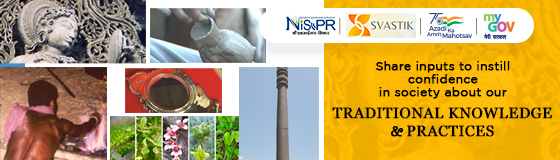
Share inputs to instil confidence in society about our traditional knowledge and practices

Share inputs to instil confidence in society about our traditional knowledge and practices
Start Date :
Mar 03, 2022
Last Date :
Aug 31, 2022
23:45 PM IST (GMT +5.30 Hrs)
Submission Closed

India has a rich legacy of practices and knowledge touching different spheres of life and a scientific heritage traversing various Science & Technology (S&T) domains. The ...

India has a rich legacy of practices and knowledge touching different spheres of life and a scientific heritage traversing various Science & Technology (S&T) domains. The traditional knowledge of India is available in various forms such as classical texts, manuscripts and/or as oral communication that has been passed on over thousands of years. This valuable knowledge is often part of our daily practices as well. Some of the traditional practices are livelihood means of the concerned knowledge holders. Our traditional practices exist in synergy between human needs and nature, often balancing resources and requirements in a local context. However, with time, India’s Traditional Knowledge Systems are eroding rapidly, and the nation has also been witnessing erosion in people’s faith towards our traditional knowledge. A grave concern is the mindless attitude of some to mimic non-Indian cultures and disdain for our traditions. It’s important to recognize that traditional heritage is an integral part of any country’s development and progression. This calls for necessary attention and action from the concerned stakeholders in the country to build further on our scientific inheritance. Only a well-informed and balanced society can drive the advancement of the country.

Under the visionary leadership of our Hon’ble Prime Minister and President, CSIR Society, Shri Narendra Modi, the Council of Scientific and Industrial Research (CSIR) is spearheading the efforts to collaborate with the relevant partners from across the country and implement the national initiative SVASTIK (Scientifically Validated Societal Traditional Knowledge) for communicating India’s traditional knowledge to the society. CSIR-National Institute of Science Communication and Policy Research (CSIR-NIScPR) is the nodal organization to implement this national initiative.

The prime mission of the initiative is to conserve scientifically validated traditional practices, and instil confidence in citizens regarding the scientific values of our traditional knowledge/practices.

We invite the suggestions of academicians, researchers, subject-matter experts, students, NGOs, and the public on how to instil confidence in society about our traditional knowledge and practices. This will help us in our mission to inculcate a scientific temper and instil confidence in citizens by stimulating the Science-Scientist-Society connect towards our traditional knowledge and practices.

Click here to read more about the SVASTIK Initiative of CSIR-NIScPR. (PDF 1519 KB)
Or visit the website - https://niscpr.res.in/nationalmission/svastik

How much are you aware of our traditional knowledge and practices? Participate in MyGov quiz and check your awareness of the traditional knowledge of India. Quiz Link: https://quiz.mygov.in/quiz/quiz-on-indian-traditional-knowledge/

The last date to share your ideas and suggestions is 31st August 2022.

Reset
Showing 2022 Submission(s)
VENKATA MAMIDANNA
VENKATA MAMIDANNA 4 years 6 months ago
Recently when I went Newyork to attend CITIZENSHP INTERVIEW, I was happy to see big board of Ganesha Temple at about 6.30 am and I wanted to have DARSHAN after SUPRABHATA SEVA I was disappointed it is closed and open to public after 10.30 am.Many youngsters who can spare time to seek blessings of Hindu Gods before going offices or while returning home in the night at 8.30 pm are disappointed. My problem is my next visit if I die before the gates of GANESHA TEMPLE at say 9.30 pm after attending a dance programme in the attached auditorium as I usually do in Summers, some ISLAMIC PRAYER HOUSE VOLUNTEER or 911 member will take care of me and next day at 10.30 am GANESHA TEMPLE MEMBERS will burn my body as per Hindu rites. Out of several lakh Indians and Telugus Temples etc. is there not a single volunteer to keep open some help place round the click. Sometimes I return Home at 11.30 pm after a dance programme in NEW JERSEY, NEWYORK, CONNECTICT, Chicago where my second son is put up
Bhurrah Basfore
Bhurrah Basfore 4 years 6 months ago
Traditional knowledge give us the basic foundation to go head, following it, is not a bad idea, it helps us to wide open to carrying forward the previous knowledge which was came from traditional knowledge.
kunal kishore
kunal kishore 4 years 6 months ago
Traditional knowledge and practise is an assets of our country. it is a backbone of our society. 1 Traditional knowledge should be collected and compile in written form. 2 A national institute should be established for collection and their documentation. 3 A social awareness campaign should be launched for aware about society. 4 Traditional knowledge should be included in school syllabus as a subject. 5 It should be connected with scientific base and their result. 6 It should be advertise with scientific data and practices.
Neha Chhibber
Neha Chhibber 4 years 6 months ago
शीर्षक का अनुवाद "धन के विज्ञान" के रूप में किया जाता है, लेकिन पुस्तक का दायरा व्यापक है। इसमें सरकार की प्रकृति, कानून, नागरिक और आपराधिक अदालत प्रणाली, नैतिकता, अर्थशास्त्र, बाजार और व्यापार, मंत्रियों की जांच के तरीके, कूटनीति, युद्ध के सिद्धांत, शांति की प्रकृति, और एक राजा के कर्तव्यों और दायित्वों पर किताबें शामिल हैं। पाठ में हिंदू दर्शन शामिल है, जिसमें कृषि, खनिज विज्ञान, खनन और धातु, पशुपालन, चिकित्सा, वन और वन्य जीवन पर प्राचीन आर्थिक और सांस्कृतिक विवरण शामिल हैं। यह पुस्तक सामाजिक कल्याण के मुद्दों की पड़ताल करती है, सामूहिक नैतिकता जो एक समाज को एक साथ रखती है, राजा को सलाह देती है कि अकाल, महामारी और प्रकृति के ऐसे कृत्यों या युद्ध से तबाह हुए क्षेत्रों में, उन्हें सिंचाई बनाने जैसी सार्वजनिक परियोजनाओं की शुरुआत करनी चाहिए जलमार्ग और प्रमुख रणनीतिक जोतों और कस्बों के आसपास के किले और प्रभावित लोगों पर करों की छूट। पाठ अन्य हिंदू ग्रंथों पर प्रभावशाली था, जैसे कि मनुस्मृति में शामिल राजाओं, शासन और कानूनी प्रक्रियाओं पर अनुभाग।
Neha Chhibber
Neha Chhibber 4 years 6 months ago
पारंपरिक ज्ञान, कौशल और अभ्यास है जो एक समुदाय के भीतर पीढ़ी से पीढ़ी तक विकसित, निरंतर और पारित होते हैं, जो अक्सर इसकी सांस्कृतिक या आध्यात्मिक पहचान का हिस्सा बनते हैं। उदाहरण के लिए: चाणक्य जी द्वारा अर्थशास्त्र
HOXXXXXXIC
HOXXXXXXIC 4 years 6 months ago
प्रधानमंत्री जी, कृपया देश हित में * एक देश एक कानून लागू किया जाए । * जनसंख्या नियंत्रण कानून लागू किया जाए। * देश के विकास के लिए आरक्षण को पूरी तरह समाप्त किया जाए। आप देश हित में कर सकते हैं। * ऑन लाइन मतदान शुरू किया जाए जो आधार कार्ड से लिंक किया जाए। धन्यवाद.
Anil kumar lowanshi
Anil kumar lowanshi 4 years 6 months ago
Tradition.. What is tradition... I think our elders follow some rules and regulations thousands of years ago and keep it practising tiill now a days. So this journey called tradition. they follow not only ayurveda but science and facts also. They believe that god exist and we should feel him worship him. Veda, purana, aranyak are shows how to behave, how to live, how to help, how to secrfic, how to study in aashrama. Our culture and traditions are very rich , but perhaps we forget our past and want to live in vilasi life , , ,Want everything in free. Our former leaders gandhi ji, ambedkar ji, sardar vallabh bhai patel, lal bahadur shashtri ji believes in our culture thats why they did everything for their country. So we have to take oath to save our culture and tradition... Thanks
Bishal Bhowmik
Bishal Bhowmik 4 years 6 months ago
Traditional knowledge (TK) is knowledge, know-how, skills and practices that are developed, sustained and passed on from generation to generation within a community, often forming part of its cultural or spiritual identity. Innovations based on TK may benefit from patent, trademark, and geographical indication protection, or be protected as a trade secret or confidential information. However, traditional knowledge as such - knowledge that has ancient roots and is often oral - is not protected by conventional intellectual property (IP) systems. Defensive protection Defensive protection refers to a set of strategies to ensure that third parties do not gain illegitimate or unfounded IP rights over TK. These measures include the amendment of WIPO-administered patent systems (the International Patent Classification system and the Patent Cooperation Treaty Minimum Documentation). Positive protection 1)Preventing unauthorized use, and 2Active exploitation of TK by the originating community
mygov_164724323397789761
mygov_164724324497789761